
WSIB fraud costs Ontario employers millions every year. And if you’re running a business, those fraudulent claims aren’t just someone else’s problem: they’re driving up your premiums and eating into your bottom line.
The frustrating part? You might already suspect something’s off with a claim, but proving it feels nearly impossible without the right approach. The good news is that fraudulent claimants tend to make mistakes. They get comfortable. They slip up. And when you know what to look for, those red flags become a lot easier to spot.
This guide breaks down exactly what constitutes WSIB fraud, the warning signs every Ontario employer should recognize, and how professional insurance fraud investigations can protect your business.
What Actually Constitutes WSIB Fraud?
Before we dig into detection, let’s get clear on what we’re talking about. WSIB fraud isn’t just about someone faking an injury entirely: though that certainly happens. It actually takes several forms:
Malingering is when an employee exaggerates or prolongs symptoms beyond the actual recovery period. The injury may have been legitimate initially, but the claimant continues collecting benefits long after they’ve healed.
Working under the table while receiving WSIB benefits is surprisingly common. The claimant tells WSIB they can’t work, but they’re doing cash jobs on the side: sometimes in the exact capacity they claim they can’t perform.
Exaggerating symptoms involves inflating the severity of a legitimate injury to receive higher benefits or extended time off. A minor back strain becomes a “debilitating” condition that prevents any physical activity.
Misrepresenting the cause happens when non-work-related injuries get attributed to the workplace. That weekend hockey injury? Suddenly it happened moving boxes in the warehouse on Monday morning.

The Red Flags Every Employer Should Know
Fraudulent claims tend to follow patterns. None of these indicators alone proves fraud, but when you start seeing multiple red flags stack up, it’s time to pay closer attention.
The “Monday Morning” Injury
This one’s a classic. An employee reports an injury first thing Monday morning, claiming it happened late Friday. No witnesses. No incident report filed at the time. Just their word that it occurred at work before the weekend.
This pattern often indicates an injury that actually happened during personal time: at home, playing sports, or working another job: that the employee wants covered by WSIB.
Vague or Inconsistent Medical Documentation
When medical reports lack specifics or the claimant’s description of the injury keeps changing, something’s usually wrong. Watch for:
- Contradictory details about how the accident occurred
- Symptoms that don’t align with the reported mechanism of injury
- Frequent doctor changes without clear medical reasons
- Refusal to undergo diagnostic procedures that would clarify the condition
The Rumor Mill
Your employees talk. If coworkers are mentioning that the claimant was spotted at the gym, working on their house, or picking up shifts elsewhere, don’t dismiss it as gossip. These tips often turn out to be accurate: employees generally know when a colleague is gaming the system.
Suspicious Timing
Claims filed right before layoffs, after receiving poor performance reviews, or during seasonal slowdowns deserve extra scrutiny. So do injuries reported by employees with a history of frequent claims or job-hopping.
Avoiding Contact
Legitimate claimants typically cooperate with the claims process. If someone is consistently unavailable, misses medical appointments, or becomes evasive when asked routine questions, there may be a reason they’re keeping their distance.
Why Surveillance is the Gold Standard
Here’s the reality: suspicions don’t hold up in appeals or legal proceedings. You need evidence. And when it comes to proving that someone’s physical capabilities contradict their claimed disability, video surveillance remains the most powerful tool available.
A claimant says they can’t lift more than five pounds? Video footage of them loading furniture into a truck tells a different story. They claim they can’t stand for extended periods? Surveillance showing them working a full shift at another job speaks for itself.
Professional investigators working across Mississauga, Brampton, and throughout the GTA know how to conduct surveillance legally and effectively. This isn’t about catching someone in a “gotcha” moment: it’s about documenting patterns of activity that directly contradict the limitations they’ve reported.

The key advantage of video evidence is that it’s objective. It doesn’t rely on interpretation or testimony. It shows exactly what the claimant was doing, when they were doing it, and what physical demands that activity required.
Social Media: Where Fraudsters Expose Themselves
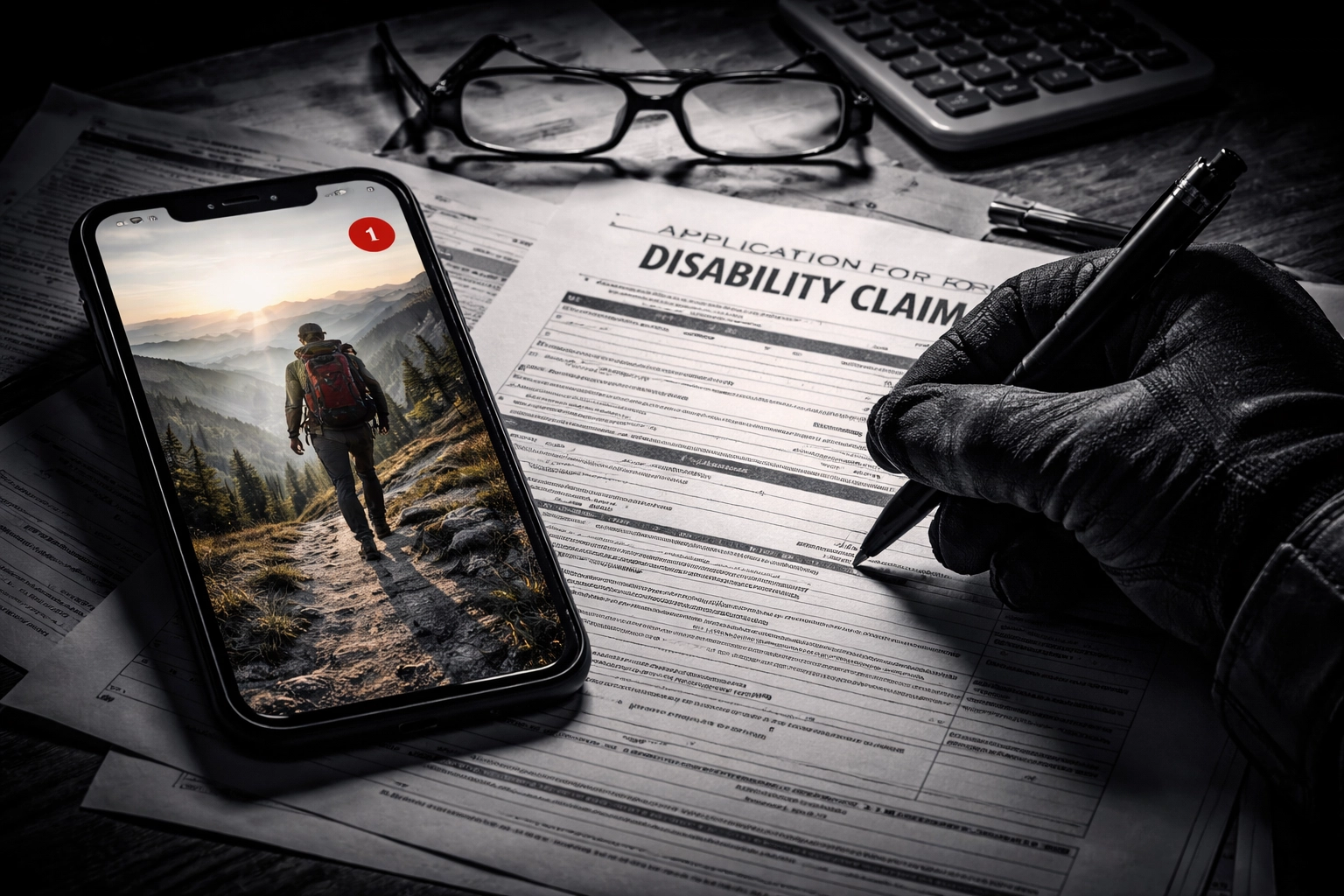
You’d be amazed how many people claiming total disability post photos of themselves hiking, playing sports, or vacationing. Social media has become one of the most valuable sources of evidence in fraud investigations.
A private investigator in Mississauga or private investigators in Brampton trained in digital investigations know how to:
- Document public posts before they’re deleted
- Identify alternate accounts and connections
- Preserve evidence in ways that maintain its legal admissibility
- Analyze metadata and posting patterns
It’s not uncommon to find claimants who restrict their main profiles but forget about secondary accounts, or whose friends and family inadvertently tag them in revealing photos.
That said, social media investigation requires careful handling. Evidence gathered improperly: through fake accounts, hacking, or accessing private information: won’t help your case and could expose you to legal liability.
Legal & Compliance: Protecting Your Evidence
This brings us to a critical point. All the evidence in the world won’t help you if it was gathered illegally. In fact, improperly obtained evidence can get your entire case thrown out and potentially expose your company to lawsuits.
Professional insurance fraud investigations ensure that:
- Surveillance is conducted in public spaces where there’s no reasonable expectation of privacy
- Evidence maintains proper chain of custody for legal proceedings
- All investigation methods comply with Ontario privacy laws and regulations
- Documentation meets the standards required for WSIB appeals and court cases
This is exactly why DIY investigation attempts often backfire. Even if you catch something suspicious, amateur evidence collection frequently renders that evidence inadmissible when you actually need it.
Working with licensed investigators covering Hamilton, Oakville, Scarborough, and across Ontario ensures your investigation stays within legal boundaries while maximizing your chances of a successful outcome.
The Real Cost of Doing Nothing
Some employers hesitate to investigate suspicious claims. They worry about seeming heavy-handed, or they figure one fraudulent claim won’t make much difference.
Here’s why that thinking is dangerous:
Your premiums are directly affected. WSIB premiums are experience-rated. More claims: especially long-duration claims: mean higher costs for your business. A single fraudulent claim that drags on for months or years can impact your premiums for multiple rating periods.
It sends a message to other employees. When workers see a colleague getting away with a questionable claim, it normalizes the behavior. One unchallenged fraud can inspire others.
Legitimate claimants suffer. Resources dedicated to fraudulent claims are resources not available to employees with genuine injuries who actually need support.
Your business reputation matters. High claim rates can affect your standing with WSIB and potentially impact future business relationships.

Why Ontario Employers Trust Facts Investigations
Detecting WSIB fraud requires expertise, discretion, and Ontario-wide coverage. At Facts Investigations, we’ve built our reputation on delivering all three.
Our team conducts insurance fraud investigations across the province: from downtown Toronto to Sudbury and Sault Ste. Marie. We understand Ontario’s legal landscape, WSIB’s processes, and what evidence actually holds up in appeals and legal proceedings.
When you work with us, you get:
- Experienced investigators who specialize in insurance fraud and understand the tactics fraudulent claimants use
- Legally admissible evidence gathered through proper methods with documented chain of custody
- Discretion that protects your company’s reputation and the integrity of the investigation
- Comprehensive reporting that clearly presents findings in formats suitable for legal and administrative proceedings
Suspecting fraud is frustrating. Proving it requires professional investigation. If you’ve got a claim that doesn’t add up, contact Facts Investigations for a confidential consultation. We’ll help you understand your options and determine the best path forward for your specific situation.